
As industrial operations across oil and gas, petrochemical, marine energy, and environmental protection sectors continue to expand globally, the choice between onshore and offshore skid packages has become a pivotal factor in project planning. As an experienced offshore skid package engineering manufacturer, STE has gained increasing recognition for its ability to meet the stringent requirements of remote and high-risk environments. Skid systems—whether onshore or offshore—serve as fully integrated process modules that consolidate pumps, compressors, heat exchangers, instrumentation, and control systems into a single unit, reducing installation complexity, enhancing operational reliability, and optimizing plant workflow. For project teams, understanding the engineering considerations, logistical challenges, and cost implications of each skid type is essential to ensure project success and long-term operational efficiency. STE, a professional OEM industrial skid manufacturer since 2008, leverages extensive technical experience and a global operational perspective to guide clients in selecting the optimal skid solutions for their industrial applications.Engineering Considerations for Onshore Skid Packages
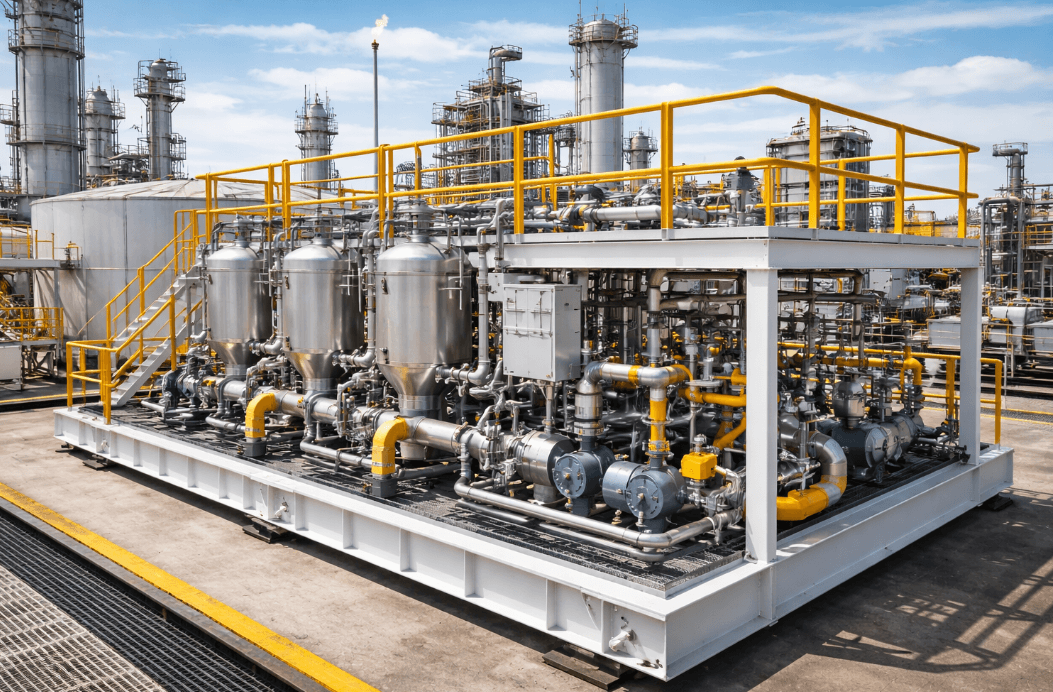
Onshore skid packages are primarily deployed in fixed, accessible locations such as refineries, chemical plants, or water treatment facilities. The engineering focus for onshore skids emphasizes durability, process integration, and ease of maintenance.
Stable Foundation and Structural Integrity
Onshore skids can be designed with heavier structural supports and foundations, taking advantage of the stability provided by land-based facilities. This allows for larger equipment integration, higher weight capacities, and the installation of auxiliary components without compromising structural integrity.
Optimized Process Integration
Onshore skids benefit from the ability to connect directly to existing plant infrastructure. Piping layouts, electrical systems, and instrumentation can be seamlessly integrated into the plant’s operations, enabling continuous process control, efficient energy use, and minimal operational interruptions.
Maintenance and Accessibility
Maintenance is simpler onshore due to easier access for inspection, repair, and replacement of components. Skid systems can be designed with modularity for future upgrades or expansions, reducing lifecycle costs while maintaining operational flexibility.
Design Flexibility and Scalability
Onshore skid packages allow for larger dimensions, higher payloads, and more complex system configurations. Facilities can implement multi-unit installations with standardized or customized modules tailored to long-term production goals.
Engineering Considerations for Offshore Skid Packages
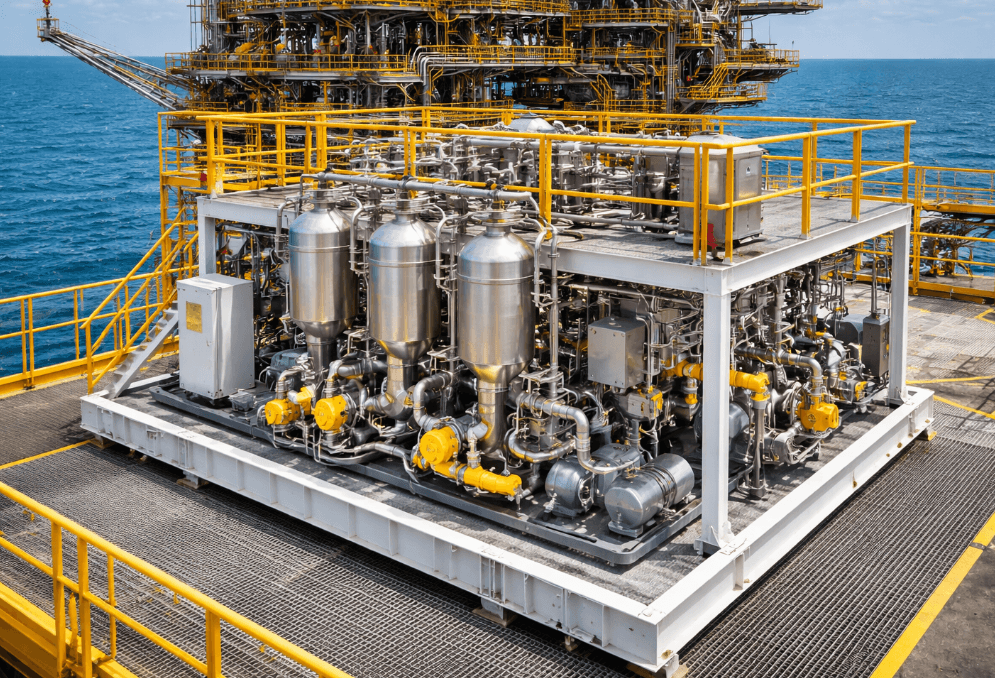
Offshore skid packages face unique challenges due to their deployment in marine and remote environments. These systems must address mechanical stresses, safety requirements, and transportation constraints while maintaining operational efficiency.
Robust Structural Engineering
Offshore skid packages require reinforced frames, vibration-resistant supports, and corrosion-resistant coatings to withstand extreme wind, waves, and saltwater exposure. These structural adaptations ensure longevity and reduce the risk of operational failures.
Compact and Modular Design
Space on offshore platforms is highly limited. Skid systems must maximize usable volume, condense equipment layouts, and ensure all critical components are fully integrated without compromising safety or accessibility. Precision modularity also simplifies transport and offshore installation.
Enhanced Safety and Compliance
Offshore skid packages must comply with strict safety regulations, including fireproofing, emergency shutdown systems, and containment for hazardous materials. Redundant monitoring systems and automated controls mitigate risk in isolated environments.
Transportation and Installation Constraints
Design considerations include offshore transport by barge or heavy-lift vessels. Skid modules must be pre-assembled to minimize on-site work, reducing the risk of human error and shortening installation timelines. Lifting points, weight distribution, and handling requirements are critical factors in engineering offshore skids.
Cost Analysis: Onshore vs. Offshore
Cost considerations differ significantly between onshore and offshore skid solutions.
Initial Fabrication and Engineering Costs
Offshore skids typically incur higher upfront costs due to specialized materials, reinforcement for marine environments, and compact modular design. Onshore skid fabrication costs are generally lower, leveraging standard construction materials and less stringent transportation constraints.
Installation and Logistics
Offshore installations require marine transport, specialized lifting equipment, and coordination with platform schedules, adding to project expenses. Onshore skids benefit from simpler site access and direct connection to plant infrastructure, reducing logistics costs.
Maintenance and Lifecycle Costs
Offshore skid packages demand corrosion protection, periodic inspections, and higher operational monitoring, which may increase lifecycle costs. In contrast, onshore skids are more accessible, allowing for routine maintenance at lower expense, though they may require more space and land-based infrastructure investments.
Operational Efficiency and Risk Mitigation
While offshore skids are costlier upfront, their precision engineering reduces operational risk, downtime, and potential environmental hazards. Onshore skids can provide cost savings through standardization, scalability, and simpler integration into existing systems.
STE’s Expertise in Onshore and Offshore Skid Packages
STE combines more than 15 years of technical experience with global market insight to deliver tailored solutions for both onshore and offshore applications. Key competitive advantages include:
Engineering Excellence
Advanced 3D modeling, process simulations, and integration planning ensure each skid is optimized for operational efficiency, safety, and longevity, whether deployed onshore or offshore.
Fabrication Capacity
With a 20,000-square-meter production facility in Qidong, STE accommodates both single customized units and large-scale standardized solutions, leveraging a skilled workforce of over 100 technicians and 60 professional managers.
Global Logistics and Project Management
STE’s experience in international deployments ensures timely and safe transportation, including handling the complexities of offshore installation. Pre-assembly and modularity minimize on-site work and reduce project risks.
Comprehensive Client Support
From design and fabrication to commissioning, operator training, and troubleshooting, STE provides end-to-end support, ensuring smooth integration, optimal performance, and long-term reliability of every skid package.
Industry Applications
STE serves offshore oil platforms, petrochemical refineries, marine energy installations, and environmental treatment facilities, delivering skid solutions engineered to the highest industrial standards while addressing unique operational challenges.
Conclusion
Choosing between onshore and offshore skid packages requires careful consideration of engineering requirements, site constraints, safety standards, and lifecycle costs. STE, as a trusted offshore skid package engineering manufacturer, offers deep expertise, global deployment capabilities, and customized design solutions to meet the complex demands of industrial operations. By combining technical excellence, precision fabrication, and comprehensive project support, STE empowers clients to achieve operational efficiency, safety, and cost-effectiveness across a wide range of industrial applications.
For more information about STE and its onshore and offshore skid package solutions, visit: https://www.ste-equ.com/.
Post time: 06-14-2026